
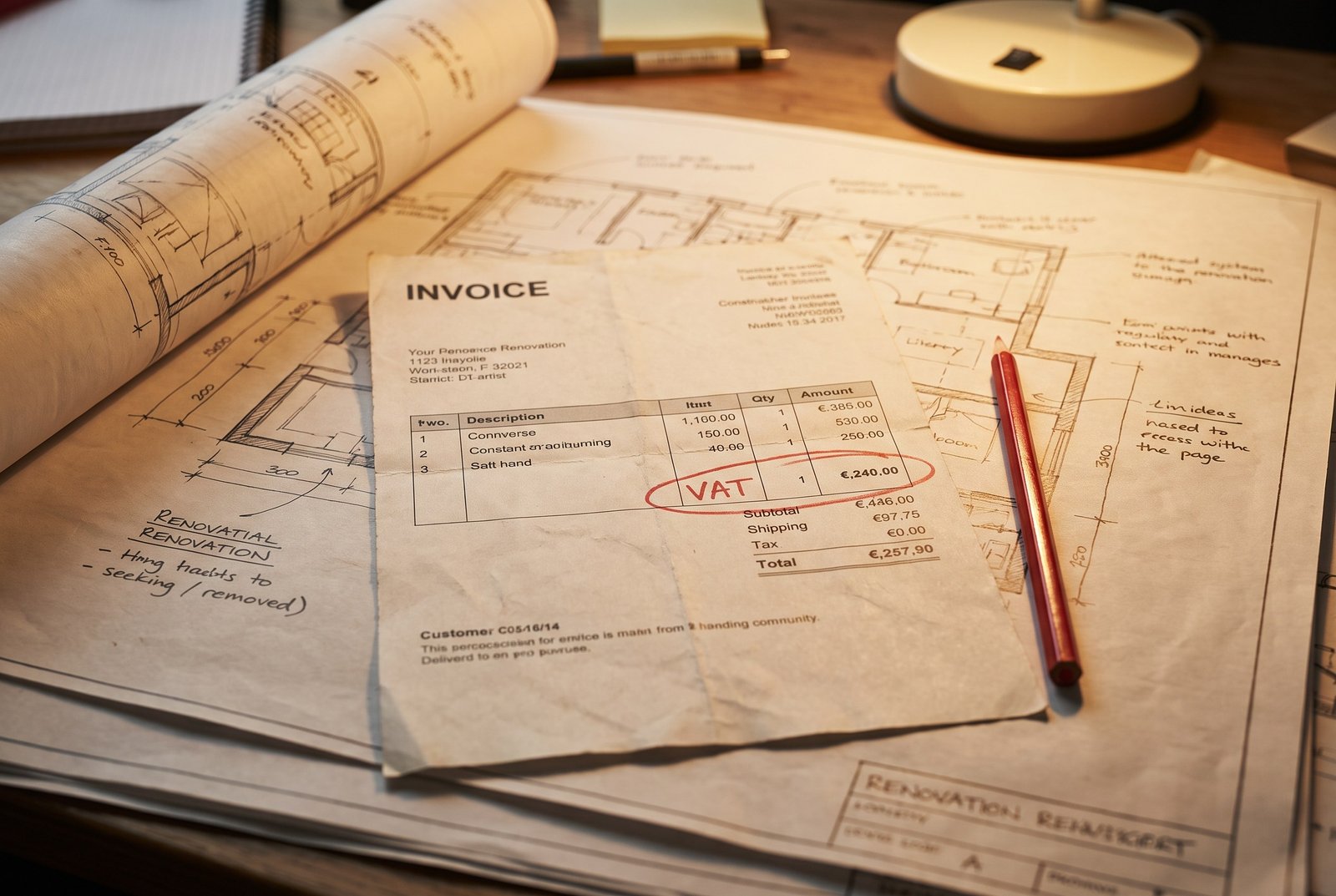
Reclaiming VAT on the purchase or renovation of a property intended for short-term letting is one of the most poorly explained tax levers in the sector — including by management companies that make a selling point of it without ever setting out how it actually works. This guide explains in concrete terms what is reclaimable, who is entitled to it, and the 20-year adjustment trap that many owners discover too late.
Reclaiming VAT is closely tied to the para-hôtellerie regime: for the full mechanism (service conditions, rates, worked examples), see our complete guide to para-hôtellerie. This guide focuses specifically on the VAT reclaim itself.
Table of Contents
At a Glance, in Order of Importance
- Reclaimable VAT covers the works, the furniture and the professional fees, not the price of the land
- You must be liable for VAT on your rental income in order to reclaim VAT on the purchase or the works
- The reclaim is made on application, through a VAT return (CA3)
- A 20-year operating commitment is required for a building, failing which part of the VAT must be repaid
- Furniture and equipment have a shorter adjustment period than the building
- Many management companies mention this advantage without ever explaining how it actually works
1. The Principle: Why VAT Is Reclaimable
When you buy a new-build property or carry out works, you pay VAT on the price — generally 20%. If your letting activity is itself subject to VAT (through para-hôtellerie or a dedicated structure), you can deduct that input VAT from the VAT you charge on your rental income, and claim the balance back from the Trésor public (the French public treasury). This is the standard VAT deduction mechanism, applied to a rental investment.
Worth remembering: without an activity subject to VAT (para-hôtellerie or equivalent), no VAT is reclaimable on your purchase or your works. That is the precondition for everything else.
- Reclaimable: renovation works and works to bring the property up to standard
- Reclaimable: furniture and white goods
- Reclaimable: architect’s fees, project-management fees and construction costs subject to VAT
- Not reclaimable: the price of bare land (outside the scope of VAT in most cases)
- Not reclaimable: expenditure unconnected with the activity subject to VAT
2. Who Can Reclaim VAT? The Eligibility Conditions
The central condition is to operate the property under a regime liable for VAT. In practice, for an individual owner that role is most often filled by para-hôtellerie (at least 3 of the 4 hotel-type services) — set out in detail in our complete guide. Certain investment structures (an SCI that has opted for VAT, serviced residences) may also qualify, under their own rules, to be confirmed with an accountant.
Plain classic furnished letting (LMNP with no hotel-type services) gives no right at all to reclaim VAT — this is the point most often misunderstood.
3. What Is Reclaimable, and What Is Not
Anything that contributes to the activity subject to VAT potentially gives a right to deduction: renovation works, furniture, equipment, architect’s fees and project-management fees. The price of bare land, by contrast, is generally not subject to VAT on a standard purchase and therefore does not enter the calculation.
4. The Procedure in Practice: from Claim to Refund
The deduction does not happen automatically: it goes through your VAT returns (form CA3), monthly or quarterly depending on your regime. In practice:
- Keep every invoice showing VAT (works, furniture, professional fees)
- Register your activity under the régime réel for VAT from the start of operation or of the works
- File your CA3 returns showing the deductible VAT on your expenditure
- The VAT credit is refunded by the Trésor public if deductible VAT exceeds the VAT you have charged
5. The 20-Year Adjustment: the Trap to Anticipate
This is the point most often left unsaid: VAT reclaimed on a building is only definitively yours at the end of a 20-year adjustment period (article 207 of annexe II to the CGI). Furniture and equipment follow a shorter period. If you stop the VAT-liable activity before that term — by reverting to classic furnished letting, for example — you will have to repay a fraction of the VAT reclaimed, pro rata to the years remaining.
Point to watch: reclaiming VAT is not a one-off gain with nothing attached. It commits you to a way of operating over the long term.
6. Worked Example: an Illustrative Case
The example below is a fictional case, built from the tax rules in force. The figures are rounded and are no substitute for a costing tailored to you by your accountant.
An older chalet bought for €420,000, with a full renovation costing €90,000 including VAT. By opting for para-hôtellerie from the start of operation, the VAT on the works (around €15,000 at 20%) becomes reclaimable from the Trésor public. In return, the commitment to operate under para-hôtellerie must be maintained over time to avoid a partial repayment. For the full reasoning, including the VAT charged on rental income, see the worked examples in our para-hôtellerie guide.
FAQ – Reclaiming VAT
No. Without an activity subject to VAT (such as para-hôtellerie), no VAT is reclaimable on your purchase or your works. This is the limit owners most often misunderstand.
20 years for a building (adjustment in twentieths if you exit early), and a shorter period for furniture and equipment. It is a long-term commitment, not a one-off benefit.
The refund comes after you file your CA3 returns, on the basis of the VAT invoices you have paid. Timescales vary according to your filing regime (monthly or quarterly).
It is possible under certain conditions, in particular if the SCI opts to be liable for VAT on its rental income. The rules differ from those applying to an individual owner under para-hôtellerie: confirmation with an accountant is essential.
A sale can also trigger a partial repayment of the VAT reclaimed, except in certain cases where the property passes to a buyer who themselves continues an activity subject to VAT. Always to be confirmed before any sale.
Sources and Further Reading
This article was written from official French sources consulted in August 2026. The rules on VAT deduction and adjustment are technical: have your situation confirmed by an accountant before making any decision.
BOFiP · impots.gouv.fr — VAT: adjustment of deduction rights
BOFiP · impots.gouv.fr — VAT: hotel and para-hotel accommodation and furnished lettings
Further reading: our complete guide to para-hôtellerie and LMP vs LMNP: which tax status to choose.
For the full detail of the regime, see our complete guide to para-hôtellerie.
Next step
Work out what your property earns before committing to works
Before committing to a renovation project under para-hôtellerie, it helps to know what your property can generate once it is up and running. Our estimator gives you an annual range in two minutes.
- 2 minutes
- No sign-up
- Mont-Blanc valley
Estimate based on classic furnished rental. We’re happy to answer questions at +33 7 66 79 73 64
A tailored comparison
Is your project eligible for a VAT reclaim?
This page sets out the general rules. Your eligibility depends on the amount of the works, the way you plan to operate the property and the structure you buy through. Tell us where you stand — we’ll get back to you within 24 business hours. Free, no obligation.
Thank you.
Your request has come through. A member of the team will call you back within 24 business hours.
Urgent question? Call us at +33 7 66 79 73 64.
We’re not lawyers or accountants. We give you the real operating figures for your property and, if your situation calls for it, put you in touch with the right professionals in the valley.
Let's Talk About Your Project
We manage more than 250 properties in the valley, in classic letting as well as para-hôtellerie operation. A question about reclaiming VAT on your own project? Our team is happy to point you in the right direction.
Share the article:
Further reading: our turnkey Airbnb property management, and our town-by-town pages — Chamonix · Megève · Saint-Gervais-les-Bains · Sallanches.

